Betting basics · winner / price / return
What is a moneyline bet? Read the winner, price and payout
By Scott Olmer, designated author and editorial owner. Draft produced October 16, 2026.
Produced through an automated AI workflow. How our editorial process works.
A moneyline bet is a wager on which team or player wins the named game, match or period. The price tells you the potential profit relative to your stake; it does not add or subtract points. Check whether the market has two or three outcomes and which game period it covers.
This guide explains the terms using fictional prices. Propeller researches player props and does not accept or place wagers.
Winner first, price second
Read a moneyline as two separate fields: the selection says who you are choosing to win; the price sets the potential profit if that selection wins.
For a fictional “Team A to win” selection priced at -150, the minus number is not a demand that Team A win by 150 points. A win by one point or ten points satisfies that winner selection, subject to the stated market rules. A point spread changes the result being compared; a moneyline price does not.
American prices also appear on other types of markets. A minus sign alone cannot tell you that you are looking at a moneyline. Start with the market label.
What does a fictional $10 return?
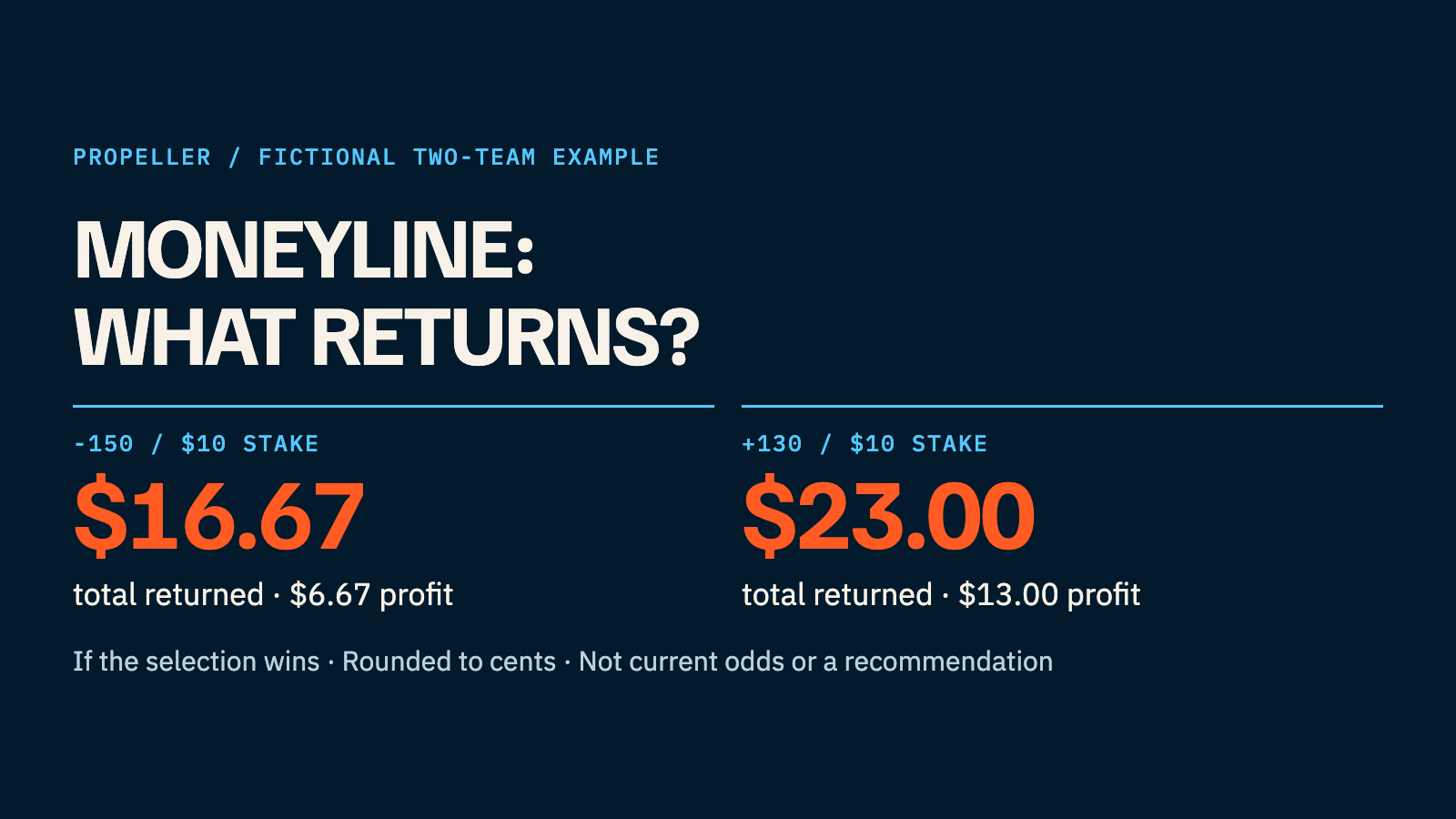
Fictional two-team example. Not current odds or a recommendation. Team A -150 and Team B +130 are separate alternatives in the same illustrative full-game, two-outcome market. Each row assumes that the chosen team wins an ordinary cash single bet. The $10 amount makes the arithmetic easy to follow; it is not a suggested stake.
| Selection | American price | Stake | Profit if it wins | Total returned if it wins |
|---|---|---|---|---|
| Team A | -150 | $10.00 | $6.67* | $16.67* |
| Team B | +130 | $10.00 | $13.00 | $23.00 |
Displayed figures are rounded to cents. Actual operator rounding may vary.
A negative American price uses a reference ratio: -150 means $150 staked to earn $100 profit. The $100 is a unit for explaining the price, not a required wager. For the fictional $10 stake:
Profit = $10 × 100 ÷ 150 = $6.666…, or about $6.67.
If Team A wins, the original $10 comes back as well. That makes the total returned about $16.67. Calling $16.67 the profit would count your own stake as new money.
A positive price works the other way around: +130 means $130 profit on a $100 stake. Scale that ratio to the same fictional $10:
Profit = $10 × 130 ÷ 100 = $13.00.
Add the returned stake and the total is $23.00 if Team B wins. Here, $13 is profit and $23 is total return. These ratios follow DraftKings’ explanation of American odds.
If either ordinary cash single loses, the returned amount is $0 and the net change is -$10. Where the applicable rules provide a push, the stake comes back: $10 returned, $0 profit. Promotional bets, cash-out offers, fees and taxes are outside this example.
Two-way or three-way? Read the period
A two-way moneyline presents two selections. A three-way market offers the draw as a separate selection, alongside the two teams. A team-win selection and a draw selection are different outcomes. DraftKings’ moneyline explanation describes both formats.
Read the period named on the market and the applicable rules for ties and overtime; the word “moneyline” alone does not settle those details. Before reading the price, identify the period, check whether a draw is an available choice, and find the relevant settlement rules. If those terms are unclear, stop there rather than assuming that every tie returns the stake or that overtime always counts.
How this differs from Propeller’s player-line research
On October 16, 2026, an AI-operated inspection of Propeller’s public analyzer page found its illustrative teaching card: Example Player, Rebounds 8.5, OVER, Model confidence 72. The card is labeled as an example, not a current pick. The inspection covered this public example, not signed-in research.
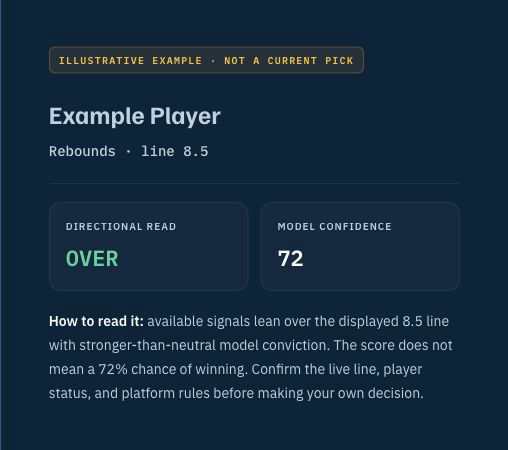
The fields answer different questions. Keeping their units attached makes the distinction easier to see:
| Field | What it answers | What the number means |
|---|---|---|
| Team A to win | Who wins this fictional named market? | A market selection, not a player-stat threshold |
| -150 | What ratio sets potential moneyline profit? | An American price, not points or confidence |
| Rebounds 8.5, OVER | Which player-stat threshold and direction does the teaching card discuss? | Rebounds and direction, not a team-winner bet |
| Model confidence 72 | How strongly do available signals support that displayed direction? | A directional score, not 72% probability or a payout |
Propeller’s score does not supply a moneyline price or tell you what a stake would return. Read how confidence scores work for that field’s limits. If you later compare prices on the same player-prop line, the no-vig explanation covers a separate calculation.
Before reading any price
- Name the selection and market. Who or what must win?
- Identify the period and draw handling. Which part of the game is covered, and is a draw a separate choice?
- Separate stake, profit and total return. Returned stake is not profit.
- Read the applicable rules. Stop if a term or settlement condition is unclear.
That sequence keeps a payout calculation from becoming an assumption about the result. A price can explain a potential return; it cannot promise a winner.
Common questions
Do I have to bet $100?
No. It is the reference unit used to explain American odds. The fictional $10 examples scale the ratio. Actual limits depend on the operator.
Does -150 mean the team must win by 150 points?
No. It is a price for the selected market, not a point spread.
Does the favorite always win?
No. The label and price do not guarantee a result.
Is every positive price an underdog?
No. A positive price can appear for the shortest-priced selection in a multi-outcome market. Compare the entire market; the sign is not a universal favorite test.
If your next question concerns a player’s stat line, see the player-line research example or follow the player-prop research guide.
Sources and scope
Primary definitions and price notation: DraftKings’ moneyline and American-odds help pages linked above, checked October 16, 2026. Product observation: Propeller’s public illustrative analyzer card, captured October 16, 2026. Calculations use the fictional inputs shown here. This is adult educational material, with no recommendation or guarantee of a result.
Watch the moneyline explanation
This educational video is restricted to adults aged 18 and older. YouTube requires sign-in to watch age-restricted videos, and it cannot play inline here. Use the YouTube link to watch, or read the complete transcript below without signing in.
Watch on YouTube (18+, sign-in required) ↗
Full video transcript
A moneyline bet names who wins the stated game, match, or period. Its price changes the potential profit, not the points a team must win by. Read the winner selection first, then the price beside it.
Here is a fictional two-team example: Team A at minus one hundred fifty, and Team B at plus one hundred thirty. We will use ten dollars to make the arithmetic concrete. These are separate alternatives, not advice to bet both, or a recommendation to stake ten dollars.
Minus one hundred fifty means a reference ratio of one hundred fifty dollars staked to earn one hundred dollars profit. You do not have to bet one hundred dollars. Scale the ratio: ten times one hundred, divided by one hundred fifty, is about six dollars and sixty-seven cents profit.
If Team A wins, add the returned ten-dollar stake. The total returned is about sixteen dollars and sixty-seven cents. That total includes your original money. Six dollars and sixty-seven cents is the profit. We are rounding to cents; actual operator rounding may vary.
At plus one hundred thirty, the calculation is ten times one hundred thirty, divided by one hundred. That gives thirteen dollars profit. Add the ten-dollar stake, and the total returned is twenty-three dollars if Team B wins. Again, twenty-three is the total, not the profit.
A losing ordinary cash single returns zero, leaving a ten-dollar loss. A push, where the applicable rules provide one, returns the stake with no profit. These calculations explain potential payouts. They do not predict which team will win.
Read the draw option and the period. A three-way market offers a draw as a separate selection. Picking a team to win is different from picking that draw. Check which game period the market covers, and read its rules for ties and overtime.
The sign is not a universal favorite test. A positive-priced selection can still have the shortest price in a market with more than two outcomes. Compare the whole market. A favorite can lose, and a price never guarantees the result.
Propeller's public teaching card, inspected by an AI workflow on October sixteenth, twenty twenty-six, shows an illustrative rebound line of eight point five, an Over direction, and a model confidence score of seventy-two. That is player-line research, not a team moneyline price. Seventy-two is not a seventy-two percent chance. This is an example card, not a current player pick.
Separate the selection, price, stake, profit, and total returned. Read the period and applicable rules before interpreting any number. The article has the example table and sources. Propeller is a research tool and does not accept wagers. This lesson is educational and intended for adults.