Check the pair before calculating
A player-prop line and a price answer different questions. The line names the statistical threshold: 25.5 points, for example. A price such as -120 describes the quoted return for one side. Knowing the threshold and an Under direction does not tell you that price.
For this two-sided calculation, collect the Over and Under quotes for the same player, game, stat, half-point line, source and snapshot. Check that settlement terms match. An Over at one book and an Under from a different time do not establish the single matched market used here.
If either quote is missing, stop: “Cannot normalize this two-sided example.” Do not fill the gap with zero, 50%, a confidence score or an older quote. Save the missing field so you know what to obtain next. A precise-looking answer made from mismatched inputs still describes the wrong question.
A fictional example, with every input named
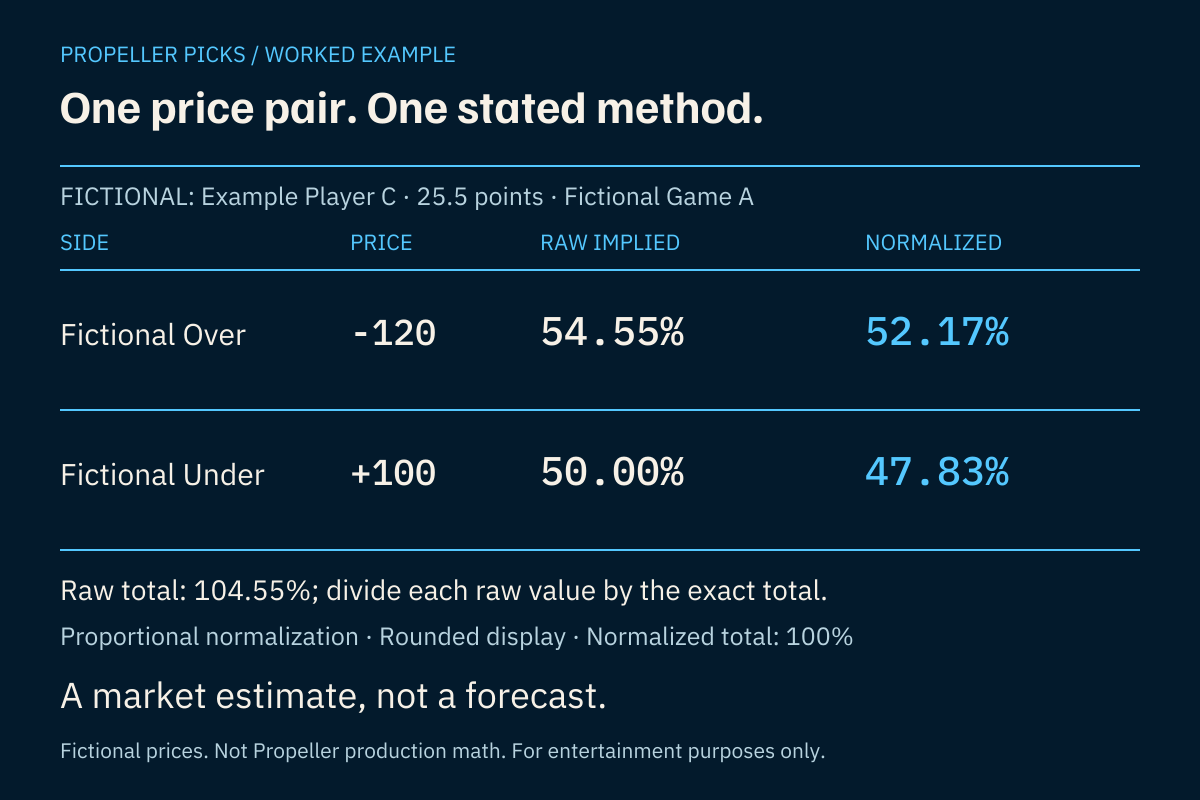
Example Player C has a 25.5-point line for Fictional Game A on Fictional Board B: Over -120 and Under +100. Both quotes belong to the same invented snapshot, September 5, 2026 at 10:00 America/Chicago. The player, event, source, prices and timestamp are all fictional teaching inputs.
Assume two exhaustive outcomes with matching settlement terms and no push, void or exchange commission. These assumptions keep this exercise to one complete two-sided market. They are not a statement about any platform’s actual rules.
Convert the quotes, then remove the excess
With negative American odds -A, A is the positive magnitude: the amount risked to win 100. Convert using A ÷ (A + 100). For -120, that is 120 ÷ 220 = 6/11, or 54.55%. With positive odds +B, B is the profit quoted for risking 100. Convert using 100 ÷ (B + 100). For +100, that is 100 ÷ 200 = 1/2, or 50.00%.
Add those raw implied probabilities. Their exact sum is 23/22, displayed as 104.55%. The excess above 100% is 4.55 percentage points, called the overround. It describes the price pair; it is not a prediction of your personal loss or return.
This example uses proportional normalization: divide each raw probability by their sum. Over becomes (6/11) ÷ (23/22) = 12/23 = 52.17%. Under becomes (1/2) ÷ (23/22) = 11/23 = 47.83%.
| Side | Price | Raw implied probability | Normalized share |
|---|---|---|---|
| Fictional Over | -120 | 54.55% | 52.17% |
| Fictional Under | +100 | 50.00% | 47.83% |
The exact normalized shares total 100%. Keep full precision until displaying results. Do not average the raw percentages or subtract 4.55 points from each side: neither operation is this proportional method. The result is a market estimate, not a forecast.
Do we have the inputs in a real Propeller record?
An AI-operated inspection of Propeller’s public analyzer on September 10, 2026 recorded Ben Rice, Stolen Bases 0.5, Under and an “80% STRONG” confidence display. The retained observation and public response establish those fields. They do not establish a matching Over/Under price pair.
This is a historical input audit, not a current line, recommendation or account of Scott’s personal use. Comparing its fields with the fictional exercise shows exactly where the calculation must stop.
| Field | Retained information | Can it supply a price? |
|---|---|---|
| Player, stat and line | Ben Rice; Stolen Bases 0.5 | Identifies the question, not its quoted return. |
| Direction | Under | No. A side is not a price. |
| Confidence display | 80% STRONG | No. Confidence is not an odds quote. |
| Matched side-price pair | Not established in this retained record | No. The two-sided calculation cannot proceed. |
This saved record does not establish the two quotes needed for the example. That does not tell us whether other public or signed-in screens show prices, or whether Propeller uses market information.
What does Propeller document?
Propeller documents no-vig market context as one available research signal. Its public wording was checked on October 11, 2026. That documentation does not verify a particular backend method, price feed, signal weight or price display on every card. The calculation above teaches a named method; it does not reproduce verified Propeller production math.
Propeller’s Confidence Score expresses model support for the displayed direction from available signals. It is not a calibrated win probability, and it cannot replace either price in this calculation. Read the confidence explanation separately when interpreting that field.
What can the result tell you?
Within the fictional pair and chosen method, Over receives 52.17% of the normalized total and Under 47.83%. That is a reproducible summary of those prices. It does not prove that the player’s true chance is 52.17%, that a selection has an edge or that it will win.
Removing the excess does not make the market’s judgment correct or an old snapshot current. Proportional normalization is the method used here to allocate the excess. Before using the result, check that the inputs still match the event and line you are researching.
Sources and a final input check
Smarkets’ explanations of implied probability and betting margins support the odds conversions and raw-sum concept; they were consulted September 17, 2026. The fractions above are independently reproducible. The historical Propeller observation remains dated September 10; its retained evidence was rechecked October 11 without treating it as a new product inspection.
Before recording a result, confirm player and event; stat and exact line; both side prices; source and snapshot; matching settlement terms; and the named calculation method. Keep missing fields visible. If the pair is incomplete, save the limitation and wait for the required quotes.
Frequently Asked Questions
Can I calculate this with just one side?
No. You can convert one quote to its raw implied probability, but this normalization requires the complete matched pair. Missing one side means “Cannot normalize this two-sided example.”
Does 52.17% mean the true chance of winning?
No. It is the fictional Over price’s share after proportional normalization. Prices and a margin-removal method do not establish the true chance of an outcome.
Can I use a pick’em payout multiplier instead?
No. An entry-level payout multiplier is not a pair of side prices for this two-outcome market. Do not substitute it into the formulas.
Is a no-vig market estimate the Confidence Score?
No. No-vig probability here comes from market prices. Propeller’s Confidence Score describes model support for a direction and is not a calibrated win probability.