What goes into a fantasy projection?
Propeller converts available current hitter-stat market components into DraftKings MLB fantasy points. For scoring components without current market coverage, it uses recent form. Each eligible hitter receives a central point estimate and lower and upper scenarios. The public feature covers MLB hitters; it does not publish pitcher projections or fantasy projections for other sports.
The point projection is the central estimate. The floor and ceiling use recent outcome variation to describe lower and upper scenarios around it. They are widened P20/P80-style estimates, not hard limits or calibrated probabilities. A player can finish below the floor or above the ceiling. The methodology page explains how those ranges are constructed.
All numbers in the examples below use DraftKings MLB fantasy-point units and one decimal place. Compare rows on that same scoring basis and slate. A similar-looking number from a different scoring system answers a different question.
Why can the first player change when I sort?
A saved public response from September 19, 2026 shows the distinction. An AI-operated inspection by Codex Astra High captured five rows; this table extracts only two. The source explicitly marked the response stale. These historical values illustrate a sorting question and recommend neither player.
Within this pair, Pete Crow-Armstrong has the higher point projection: 11.9 versus Jake McCarthy’s 10.4. McCarthy has the higher floor: 7.8 versus 0.7. Sorting by point projection puts Crow-Armstrong first; sorting by floor puts McCarthy first.
| Historical hitter | Floor | Point projection | Ceiling |
|---|---|---|---|
| Pete Crow-Armstrong | 0.7 | 11.9 | 36.4 |
| Jake McCarthy | 7.8 | 10.4 | 20.3 |
Crow-Armstrong’s point projection is 1.5 points higher; McCarthy’s floor is 7.1 points higher. Neither makes one player the best overall choice. Check the rest of each row as well as the value you sorted by.
These orders are calculations from captured fields, not observed clicks on a live board. They establish neither player’s current availability, complete-board rank, result nor suitability for a lineup. The September 19 response remains historical and stale; this article’s update date does not make it current.
One table, three different questions
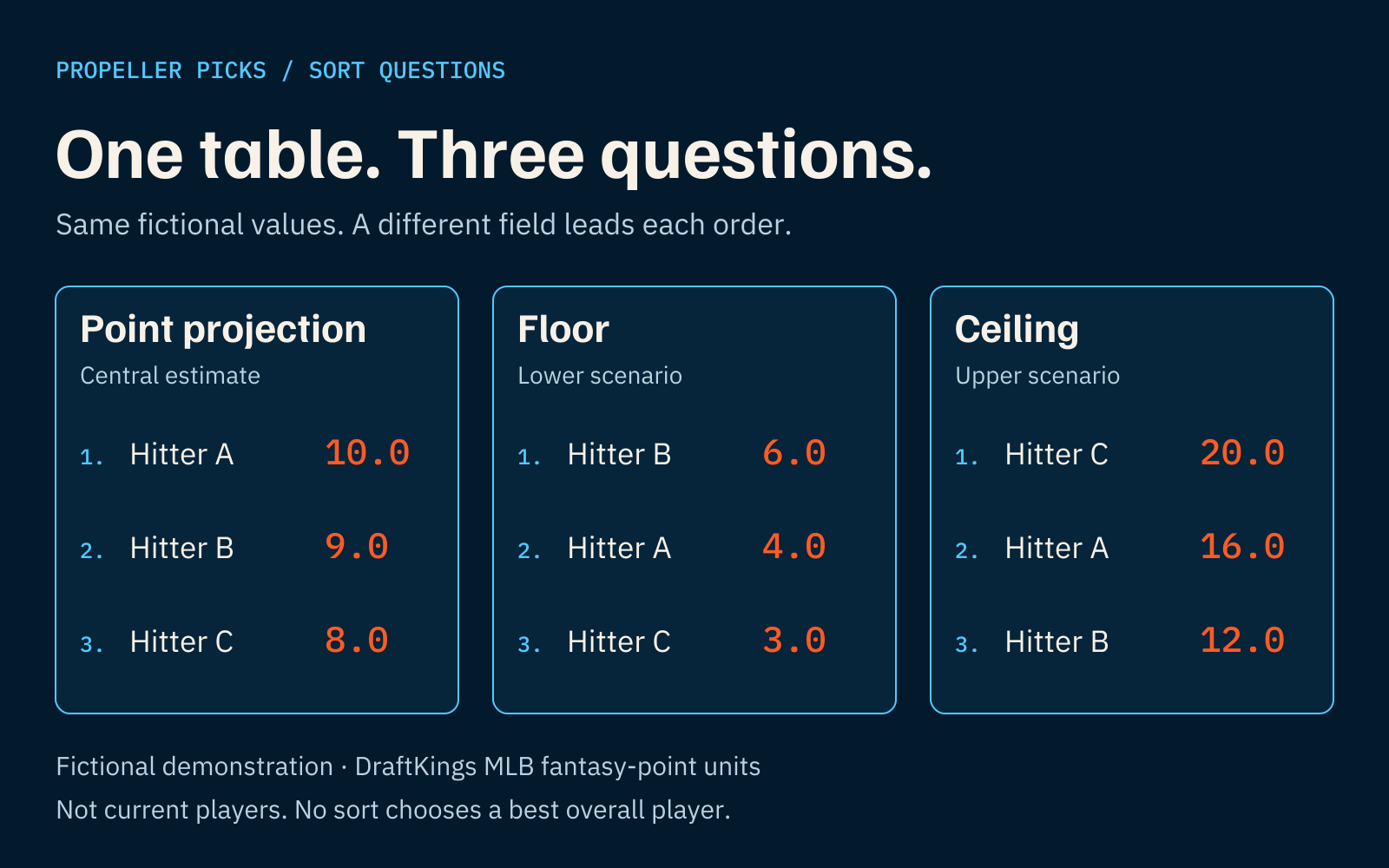
The fictional rows below make all three orders different. They share one invented slate and DraftKings MLB fantasy-point units. These are author-created teaching estimates, not model output or current players. Read one selected column from highest to lowest, then check the other two columns.
| Fictional row | Floor | Point projection | Ceiling |
|---|---|---|---|
| Example Hitter A | 4.0 | 10.0 | 16.0 |
| Example Hitter B | 6.0 | 9.0 | 12.0 |
| Example Hitter C | 3.0 | 8.0 | 20.0 |
Point projection asks: which central estimate is highest? The order is A 10.0 → B 9.0 → C 8.0. A leads on that question, while B still has a higher floor and C a higher ceiling.
Floor asks: which lower scenario is highest? The order is B 6.0 → A 4.0 → C 3.0. That makes B first in this sort. It does not promise that B will score at least 6.0 points.
Ceiling asks: which upper scenario is highest? The order is C 20.0 → A 16.0 → B 12.0. C moves from last by central estimate to first by upper scenario. That is a change of question, not evidence that C’s projection improved.
On the public MLB board, changing the sort reorders the loaded rows without recalculating their three values. This describes that board, not every signed-in screen. Averaging the three ranks would not produce a supported overall recommendation.
What should I check before using the order?
First, name the question: central estimate, lower scenario or upper scenario. Then read the selected player’s other two numbers. Keeping the full row in view prevents a single high value from standing in for everything you need to know.
Next, confirm the scoring label, slate and source status. The public board shows the source update time and labels usable data “live data” or “latest available data.” A stale source flag, missing update time or age over 60 minutes triggers the latter. If the preview cannot load usable rows, it says unavailable and keeps teaching examples labelled. A fresh page visit does not by itself establish fresh inputs.
Finally, check what the table cannot settle. Player availability and role still matter. Salary, roster constraints and contest rules can affect a lineup decision, but this feature does not import salaries, optimize lineups, manage exposure or submit entries. Propeller is independent of DraftKings and the other platforms it references.
A useful research note is simple: “I sorted by floor, compared all three values on the same slate and scoring system, and checked the source status.” Add any unresolved information before deciding what to research next. The first row is a place to inspect, not an instruction to start a player.
Frequently Asked Questions
How do Propeller fantasy projections work?
Propeller combines available current hitter-stat market components with recent form for uncovered scoring events, converts them to DraftKings MLB fantasy points, and supplies a central estimate with lower and upper scenarios.
Which players and sports are covered?
The public fantasy projection feature covers MLB hitters only. Pitchers and other sports are not part of the public launch.
Is the highest floor guaranteed?
No. Floor is a lower scenario, not a minimum result. Actual points can fall below it, just as they can exceed the ceiling.
Does sorting recalculate the projections?
The public MLB board’s sort control reorders the loaded rows by point projection, floor or ceiling. It does not recalculate the three values in that sort handler.
Is the first row a lineup recommendation?
No. It is the highest value for the selected sort within the displayed rows. Read all three values and check scoring, slate, freshness and information the table cannot settle before making your own decision.